I Stopped Trying to Fix My Body, And Something Shifted
Bianca Alleyne
Our editor tries SomaSensing, a fascia-first somatic healing practice, and discovers that the antidote to burnout might be doing less, not more.
Lately I’ve been saying yes to more wellness experiences, but not the kind that promise to reset, realign or optimise you with the help of a teacher, as I often feel they can be a little performative in essence. I have been trying to take part in experiences that reset you as a whole, more peaceful and treatment-led. So when I booked a SomaSensing session with practitioner Zeena Edwards, I logged on for my virtual session thinking this would be, in all honesty, another method to master, when in reality, I was asked to do almost nothing.
An hour later, I understood why people struggle to describe this. My shoulders, which apparently live somewhere near my ears for what has felt like an eternity, had dropped. My breath had changed without me managing it. There was a warmth and a spaciousness through my back that I can only describe as my body softening from the inside. I felt, for the first time in a while, genuinely at home in myself, and slightly stunned that it happened without a single stretch, cue or correction.
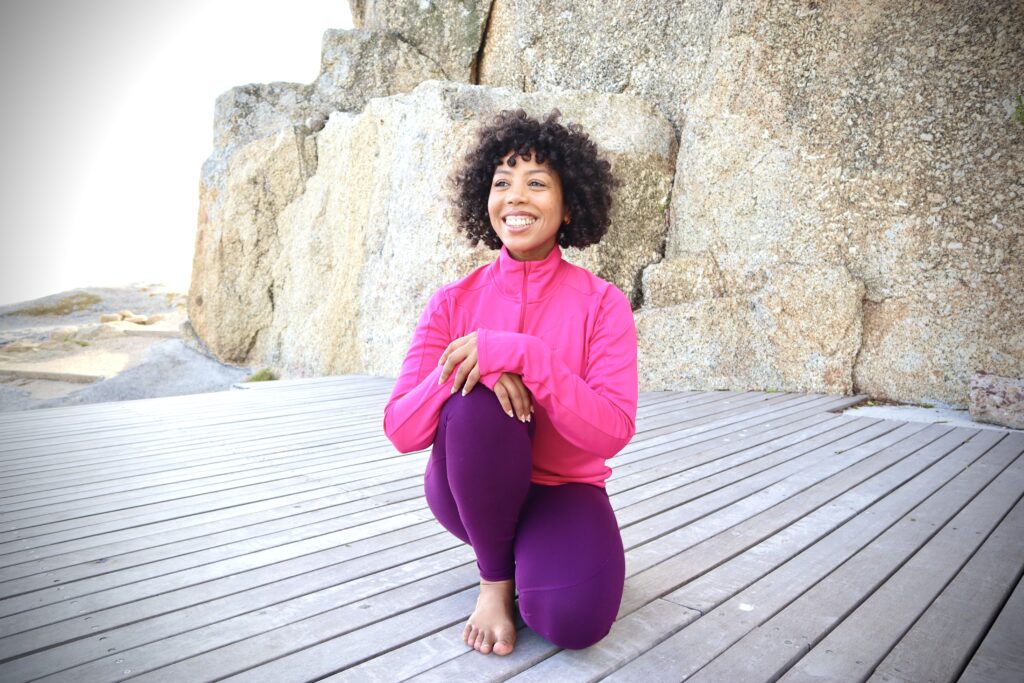
Zeena Edwards Registered Somatic Movement Practitioner
So what is it? “SomaSensing is fascia-first somatic healing,” Zeena explains. “It’s a way of returning to the body’s inner knowing and creating the conditions for the body to take care of itself.” Fascia–the soft, sensory tissue through which the body senses, shapes, and knows itself- is definitely having a cultural moment, but Zeena is quick to reframe it. “Fascia isn’t another part of the body to work on. It’s the gateway to the whole.”
Unlike massage, which works through touch from the outside, or physiotherapy with its clinical focus, SomaSensing invites you to participate from within. “We don’t stretch, force, fix or prescribe movement,” she says. “We begin with pause, quiet and rest. As strain eases, fascia reorganises, and movement may begin to emerge: a sigh, a yawn, a spontaneous stretch the body chooses for itself. There’s a name for this: pandiculation, the nervous system’s own reset button.”
It’s a quiet practice in a wellness world addicted to the next protocol. Zeena’s line, “you don’t need another method,” reallystayed with me. “Many people have become very skilled at following instructions but have lost touch with their own inner knowing,” she says. “There’s always another programme, another part of the body to correct. Yet underneath all of that, the body is already sensing, adapting and communicating all the time.”
I asked what the relentless “fixing” mindset costs us. “It can turn the body into a problem to be solved,” she says. “We override tiredness, push through strain, measure ourselves against an external ideal. The cost is often a loss of sensitivity; we no longer notice the early signals because we’ve learned to push past them.” Stiffness, fatigue and overwhelm, she insists, aren’t failures or simply ageing. “Your body isn’t failing you. It’s communicating with you.”
Zeena Edwards Registered Somatic Movement Practitioner
For anyone carrying stress or chronic tension, she’s careful to position the practice as a companion to talk therapy and medical care, not a replacement. And for the intrigued-but-sceptical, the first step costs nothing. “The heart of SomaSensing is the somatic pause,” she says. “Pause, rest, and then notice. Where do I feel strain? Can I give myself a little more space? That’s where it begins.”
I left lighter, quieter and almost evangelical, which, for a self-confessed optimiser like myself, is really saying something. Maybe the most radical wellness practice isn’t doing more. It’s finally learning to listen.
SomaSensing was founded by ISMETA-approved Master Somatic Educator Yasmin Lambat. Sessions with Zeena Edwards (@itszeenaedwards) are offered as part of her Registered Somatic Movement Practitioner training.